Wednesday, June 14, 2017

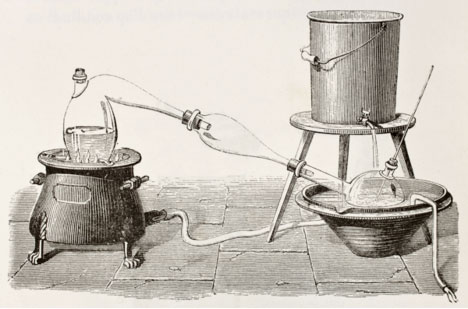
Distilling Essential Oils - An Art and a Science?

Distilling Essential Oils - An Art and a Science?

What are the Methods of Extracting Essential Oils?
There are many different ways to extract essential oils and a complete listing and description is provided here. This section will mainly deal with the details and methods of steam distillation.
What is Steam Distillation?
Distilling essential oils by steam distillation can be accomplished three different ways. They are:
  • Water Distillation;
  • Water/Steam Distillation; and
  • Straight Steam.

The Methods of Extracting
Essential Oils are Still Being Proven!

Some methods of extracting essential oils have been around for thousands of years while others are still being proven. The section will give you an understanding of the different methods!
What are the Methods of Extracting Essential Oils?
There are many different ways to extract essential oils and they are listed below:
  • Enfleurage
  • Expressed Oils
  • Steam Distillation
  • Solvent Extraction
  • Fractional Distillation and Percolation
  • Carbon Dioxide Extraction
  • Phytonic Process
What is Enfleurage?
Enfleurage is one of the oldest methods of extracting essential oils and is rarely used these days because of its high cost. It involves placing the flower petals on a layer of glass that is first spread with a thin layer of fat called "chassis". The volatile oil diffuses into the fat, then the fat is collected and the oil is extracted from the fat using alcohol.
Once the alcohol evaporates what is left behind is called the absolute. As you can imagine, this is a very time consuming process, but it was the only way to extract delicate flowers like Jasmine for a very long time!
What is Expression of Oils?
When oils are taken from the rind of fruits they are called "expressed oils". This method is cold and does not involve any solvents or heat of any kind. Most of the citrus oils are extracted in this manner including grapefruit, lime, orange and lemon essential oils.
These are not technically considered essential oils for this reason, but they are still definitely therapeutic oils. The most important thing to consider with cold pressed oils is the source of the crop since citrus fruits are constantly sprayed with pesticides and it can be very concentrated in the oil!
What is Involved in Steam Distilling Essential Oils?
Steam distillation has been used for hundreds of years and today remains one of the most favorably methods of extracting essential oils. Technically speaking if it not extracted using steam distillation or cold expression it is not a therapeutic grade essential oil.
There are actually three different steam processes that are described further in the distilling section. But in all of the methods, steam is used to rupture the oil membranes in the plant and release the essential oil.
The steam carries the essential oil to a condenser and then as it re-liquefies the lighter essential oil floats on top. The water and oil is then separated and the water portion is referred to as the hydrosol, hydrolat, or flower or floral water. And the oil portion, of course, is the essential oil!
The essential oil distilling equipment including the condenser, separator and cooking chambers can all have an enormous impact on the quality of the oil. As well as, the distillation temperature and pressure! And even if everything appears correct, the process can still produce oils that don't meet the AFNOR Standards. So essential oil distillers must have the knowledge and expertise to know how to produce therapeutic grade essential oils.
Are you interested in learning more about steam distillation? Then click here!
What is Solvent Extraction?
Solvent extraction is a method of extracting essential oils that is dominated by the perfume industry. And technically does not produce therapeutic grade oils because chemicals such as hexane, acetone, di-methylene-chloride and others are used in the process!
Did you know that the plant material is actually immersed into the solvents to become a thick substance called "concrete"?
The oil particles are released when the concrete substance is then mixed with alcohol. Once it is separated out, the chemicals remain in the oil and the oil is used by the perfume industry. These are perfume or aromatherapy grade oils and are not therapeutic grade!
As you can see this is process requires far less time and expense because the oil is cut with solvents and can increase the oil production volume significantly.
Are these the oils that are used in bath oils and gels, candles, shampoos, toothpaste, fly spray, and air fresheners?
Yup, you got it! These are also the 98% of the oils sold in health food stores, retail outlets and aromatherapy suppliers!
What is Percolation and Fractional Distillation?
Fractional distillation separates the volatile oil in different fractions or portions at various boiling points. This is used in oil refineries for distillation of petroleum products and is not suited for therapeutic grade essential oils.
Percolation is one of the newer methods of extraction essential oils. It is similar to normal distillation but the equipment is literally upside down! It has been used successfully in France; however sometimes an emulsion is produced that can not be separated out, so until it can be further developed you will not see it on a large scale.
What is Super Critical Fluid Extraction? (Carbon Dioxide Extraction)
Super critical fluid extraction or carbon dioxide extraction is also a fairly new solvent extraction process that uses carbon dioxide at very high pressure. The carbon dioxide is injected into the tank where the plant material is contained and acts as a solvent to extract the oil.
The carbon dioxide is colorless and odorless liquid and can be completely removed which is a good thing; however, there is no research at this point to verify if there are any effects of using this procedure.
Additionally, the distilling equipment is extremely expensive. So until more is known about this process, it is advised to use only steam distilled and expressed oils!
What is the Phytonic Process?
The Phytonic process is a one of the newest methods of extracting essential oils using non-CFCs (non-chlorofluorocarbons). It is also called Florasol Extraction and the oils are referred to as phytols.
What Else is There to Know about Methods of Extracting Essential Oils?
Well, if this section spurred your interest definitely read the section on steam distillation. I will give you some examples of ideal pressures and temperatures for distilling several oils, and tell you other ways that distillers adulterate their oils! So check it out!
I hope this section on methods of extracting essential oils, gave you an understanding on why using therapeutic grade essential oils are so important.
The perfume grade oils still contain a portion of the solvent and are only for fragrance so please do be careful.

How Are Essential Oils Extracted?

Essential oils can be extracted via two key methods: Distillation (includes hydrodistillation) and Expression.
Absolutes, other the other hand, can be extracted via Solvent extraction or Enfleurage, although enfleurage is rarely performed in the modern day.
Another type of aromatic product available on the market are CO2 extracts, referred to simply as that, CO2 extracts. They differ in chemistry from their related distilled essential oils but are becoming increasing available on the market.

The Practice of Distillation

Distillation appears to have been practiced throughout ancient times. Based upon the current interpretation Paolo Rovesti’s discovery of an earthenware distillation apparatus, the production or extraction of aromatic oils by means of steam distillation, has been known for 5000 years.1 During the fifth century AD, the famed writer, Zosimus of Panopolis, refers to the distilling of a divine water and panacea. Throughout the early Middle Ages and beyond, a crude form of distillation was known and was used primarily to prepare floral waters or distilled aromatic waters. These appear to have been used in perfumery, as digestive tonics, in cooking, and for trading.
Although an extensive trade of odoriferous material has been shown to have occurred in the ancient Orient and ancient Greece and Rome, the oils used were not essential oils per se, “rather they were obtained by placing flowers, roots, and other plant material into a fatty oil of best quality, submitting the glass bottles containing these mixtures to the warming influence of the sun and finally separating odoriferous oil from the solid constituents”.2

Tuesday, May 9, 2017

Fwd: What's new in The Water Network | by AquaSPE


Sent from my iPhone :-)

Begin forwarded message:

From: Meg Whitmer <meg@megwhitmer.com>
Date: May 9, 2017 at 1:46:55 PM EDT
To: Eric Weaver PhD <stars2man@icloud.com>, Maria Sgambati <sgambati2012@gmail.com>
Subject: Fwd: What's new in The Water Network | by AquaSPE

Eric - FYI, see below. 
Are you on this Water Network? 


Meg Whitmer

Meg Whitmer Landscape Architect LLC
Florida Lic #LA1038
772.708.7056
meg@megwhitmer.com

Coastal Landscapes and Living Shorelines
Landscape Design and Management
Public Parks and Gardens

"Let the beauty we love be what we do. There are hundreds of ways to kneel and kiss the ground"
Rumi


Begin forwarded message:

From: The Water Network | by AquaSPE <no-reply@thewaternetwork.com>
Subject: What's new in The Water Network | by AquaSPE
Date: May 8, 2017 at 8:09:32 PM EDT

Daily updates from The Water Network | by AquaSPE

Questions (1)
Temple Oraeki May 8, 2017 09:48

Biodigester in Households for Sludge Treatment

How can a ​biodigester ​be successfully ​implemented in ​a household to ​generate energy ​and treat ​faecal sludge? ​Which type of ​biodigester is ​the most ​convenient for ...

Notices (2)
Karen Delfau May 8, 2017 07:47

Best practices for cost recovery in implement water management frameworks in international development / developing countries. In a recent Kini interview with Peter Sharry of Axiom Water Technologie...

Show more
Prof. Dr. Hilmi S. Salem May 8, 2017 19:40

Abstracts: International Conference on Climate Change, Biodiversity and Food Security in the South Asian Region. Punjab State Council for Science & Technology, Dept. of Science, Technology & Environm...

Show more
Articles (3)
Vishakha Rajput May 8, 2017 08:39

Why Modernize Water Data Management?

A new guide "5 Reasons to Modernize Water Data Management" written for government decision makers with oversight for water resource monitoring by Aquatic Informatics. This new guide descr...

Water Network Research May 8, 2017 11:36

Emefcy and RWL Water Merge to Become Fluence

Emefcy Group Limited has signed a letter of intent to merge with RWL Water. The merger aims to create a global provider of innovative, distributed water and wastewater treatment solutions. It is anti...

Water Network Research May 8, 2017 14:14

Blackstone to Invest in Italy's De Nora

Blackstone announces that funds managed by Blackstone Tactical Opportunities, have agreed to make a substantial investment in De Nora, designer, manufacturer and supplier of electrode and water techn...

Recent content in your groups

Aquapreneurs
Notices (1)
Peter McChesney May 8, 2017 22:11

Introducing the MadiDrop, the easy to use, economical, socially preferred solution for safe drinking water 

Show more
   
Change notification settings

Saturday, April 29, 2017

Whirlpool Corporation

https://www.zera.com/

FOOD SCRAPS TODAY,
FERTILIZER TOMORROW
Zera™ Food Recycler is designed to fit seamlessly into your kitchen and make the most of your food — turning today's food scraps into tomorrow's ready-to-use, homemade fertilizer

Saturday, February 11, 2017

Joint Statement on Rights and Freedoms of Students | AAUP

Joint Statement on Rights and Freedoms of Students | AAUP


Academic institutions exist for the transmission of knowledge, the pursuit of truth, the development of students, and the general well-being of society. Free inquiry and free expression are indispensable to the attainment of these goals. As members of the academic community, students should be encouraged to develop the capacity for critical judgment and to engage in a sustained and independent search for truth. Institutional procedures for achieving these purposes may vary from campus to campus, but the minimal standards of academic freedom of students outlined below are essential to any community of scholars.
Freedom to teach and freedom to learn are inseparable facets of academic freedom. The freedom to learn depends upon appropriate opportunities and conditions in the classroom, on the campus, and in the larger community.1Students should exercise their freedom with responsibility.
The responsibility to secure and to respect general conditions conducive to the freedom to learn is shared by all members of the academic community. Each college and university has a duty to develop policies and procedures that provide and safeguard this freedom. Such policies and procedures should be developed at each institution within the framework of general standards and with the broadest possible participation of the members of the academic community. The purpose of this statement is to enumerate the essential provisions for students’ freedom to learn.

Sunday, January 15, 2017

Sustainability Symposium 2017: Ready for Anything


ICC is proud to be a sponsor of Green Builder Media's Sustainability Symposium 2017: Ready for Anything on January 9, 2017 at the Dr. Phillips Center for Performing Arts in downtown Orlando, a pioneering event that will bring together some of the nation’s top influencers to identify the threats posed by a changing climate, challenge conventional development and economic models, and explore intelligent solutions for a resilient future.

The Symposium is drawing today’s most forward-thinking building professionals, business leaders, city planners, sustainability advocates, elected officials, and national media.

>>>  BIG issues came up like getting mass-transit, trains, and more bikes. . . 

HOWEVER, My Question,
If we build transit and rail here in Florida and reduce the roadways for people to walk and bike. 
·      Who will employ all the gas station attendants, and mechanics in repair shops that lose work? 
·      What will happen to the glut of No-Fault Insurance policies, emergency rooms and ambulance chasers who all rely on the hourly car accidents?
·      Half the industry here in Florida is addressing cars and accidents? 
·      Where will all these jobs go?
·      What new income will replace these?

Saturday, November 19, 2016

SOLAR CITIES: Taking up the Energy Challenge in Maasai Mara

SOLAR CITIES: Taking up the Energy Challenge in Maasai Mara


How to build your own Solar CITIES solar heater

How to build your own Solar CITIES solar heater 
Click on the image to see detailed plans for building your own Solar CITIES system like we build them in Cairo with the Zabaleen

Friday, November 18, 2016

RE: Organic Seminole Heights Sweet Potatoes....

ORGANIC, NATIVE, wicked SHARP GINGER!

All the greens, stalks all fresh, my pot to yours!


Kind Regards,

Eric


Eric R.R. Weaver, MBA, MSM, ABD

Assistant to the Director, USF Office of Global Sustainability:

          Peter Stiling, Ph.D.

          Assistant Vice Provost – Strategic Initiatives

          Director, USF in London Programs

          Director, USF Office of Global Sustainability

          University of South Florida

eweaver@usf.edu

http://www.usf.edu/provost/office-of-sustainability/

Office: (813) 974-8337  -o-  iPhone: (813) 616-0164


Research Associate, Patel College of Global Sustainability, CGS 242

http://eweaver.myweb.usf.edu/

University of South Florida, 1710 USF Maple Drive, Tampa

http://global.usf.edu/downloads/PatelCenterMap.pdf


From: Eric [mailto:stars2man@yahoo.com]
Sent: Friday, November 18, 2016 8:08 PM
To: The Refinery <thetamparefinery@gmail.com>
Cc: Weaver, Eric <eweaver@usf.edu>
Subject: Re: Organic Seminole Heights Sweet Potatoes....


WHAT are you making for Christmas?!?!?!

My wife wants me to harvest the ginger. . . It's over a hundred pounds now.  6-7 foot Bright Green stalks and leaves too.

I have a truck to move it, and 8-Bell Jugs to seal a mix too;-)

Eric 813-616-0164 iPhone MSG


From: The Refinery <thetamparefinery@gmail.com>
To: Eric <stars2man@yahoo.com>
Sent: Tuesday, September 9, 2014 5:26 PM
Subject: Re: Organic Seminole Heights Sweet Potatoes....


Actually, I forgot to leave a check. I'll have them pay cash. 

On Tuesday, September 9, 2014, Eric <stars2man@yahoo.com> wrote:

certainly, but I don't have the total weight yet.. . .


From: The Refinery <thetamparefinery@gmail.com>
To: Eric <stars2man@yahoo.com>
Sent: Tuesday, September 9, 2014 4:45 PM
Subject: Re: Organic Seminole Heights Sweet Potatoes....


Sounds fair to me. Can I leave a check for you? I'm not in on Tuesday nights. 

On Tuesday, September 9, 2014, Eric <stars2man@yahoo.com> wrote:


Hi Greg,


I can bring the papaya to you tonight, two milk crates full.  As for the potatoes, I'll try to grab some fresh clipped greens before I come, so you can get them immediately and see if that can work better for you.


Rolling Oats told me that the Organic Papaya is selling for $5/lb, but they have not been able to get any lately.  However, the regular Papaya is usually less than $2/lb.   Would $3/lb be ok for you tonight?  I will put the crates on a scale before I come.


Eric


From: The Refinery <thetamparefinery@gmail.com>
To: eric <stars2man@yahoo.com>
Sent: Tuesday, September 9, 2014 3:00 PM
Subject: Re: Organic Seminole Heights Sweet Potatoes....


Hi Eric,

I've been off for the last couple of days, so haven't seen this.

Although I like the sweet potato greens, they wilt so quickly that it's hard for me to utilize them before their gone. Sad fact. Their delicious, but I have to be able to make money from them.

I'll buy te green papayas, if you still have them.

Greg


On Sun, Sep 7, 2014 at 11:56 AM, eric <stars2man@yahoo.com> wrote:

So the papaya tree came down!  Too much fruit on it!  Three crates of green papaya, plus the stalk and leaves if u want it  NOW!!!

Sent from my new iPod


On Sep 7, 2014, at 11:11 AM, Eric <stars2man@yahoo.com> wrote:

Good Morning Greg and Michelle,


I hope you liked my last delivery of samples for you.  I would also like to do this more regularly. . .


I'm picking my first ripe Papaya today, while the remaining 2 dozen are still green.  How did you like those green last time?  Could you use them?


I could fill a milk crate with fresh Potato greens every other week.  I've been trying to keep the potatoes in a big garden box and just clipping the over growth would give you a bunch of the fresh green tips.   I know you liked the Ginger too.  Do you want the leaves, stalk and root or which parts of it would you use?


The Italian oregano is growing like crazy too.  I think I gave you a foot or two of stalk covered with fresh leaves.


What do you feel about a crate of fresh green potato tips, stalk of Ginger and Oregano for $20?  I'm about 5 minutes north of you, and would prefer to put these into your hands immediately after picking. . . tell me what you think!


I also wanted you to meet Ryder: http://youtu.be/0uIEoSPDDU0?list=UUcHORvAGDsj28UD1Yolv5NQ   He earned a Masters from USF's Patel College of Global Sustainability and is now exploring developing Aquaponics systems run by elementary school students.  When I first met him (before his volunteer hours rebuilding my patent), he was completing a entrepreneurial business plan assignment tying this http://eweaver.myweb.usf.edu/resume/GreenhouseFlyer.pdf to a beer still to create a symbiotic ecological system. 


Would you be interested in exploring opportunities to help develop more of these ideas to increase Urban Agriculture Productions locally?


Look forward to your reply.


Eric


Eric R.R. Weaver, MBA, MSM, Research Associate
Patel College of Global Sustainability, CGS 235
University of South Florida, 11710 USF Maple Drive
http://eweaver.myweb.usf.edu/

eweaver@usf.edu


From: The Refinery <thetamparefinery@gmail.com>
To: eric <stars2man@yahoo.com>
Sent: Sunday, February 24, 2013 10:07 AM
Subject: Re: Organic Seminole Heights Sweet Potatoes....


I can take what you're willing to sell me.


Centers for Public Health Education and Outreach

Centers for Public Health Education and Outreach


Healers' Healing and Resiliency In the Aftermath of Disaster

Emergency Readiness Rounds are a series of sessions covering current issues and controversies in emergency readiness and response. Are you prepared to take the lead in your hospital, public health agency, or health service organization during a disaster? How would you make decisions about allocating scarce resources? What is the role of the emergency incident command system in a health service delivery system? These and many other questions are answered and raised during the sessions. This event was held on September 05, 2007

Friday, October 21, 2016

The Ags » Education

The Ags » Education


Education

TheAGS believes that one of the most effective ways of making progress towards sustainability is though training and providing opportunities for the next generation of leaders, and therefore strongly supports student initiatives in sustainability.

Friday, October 7, 2016

How to Make Heavenly Homemade Wine...

How to Make Heavenly Homemade Wine...

Equipment

3 gallon stoneware crock

Three 1 gallon jugs (recycled Carlo Rossi jugs work very well)

2 airlocks with rubber stoppers and a siphoning tube

Funnel

Fine mesh strainer
Notes: You will also want to wash up used wine bottles, invest in a couple of new corks and a corker if you plan on bottling any wine. The recipe below is for one gallon of fruit wine, which amounts to approximately five 750 ml bottles of wine.
Another note, the process is pictured in a glass pitcher in order to show what your results will look like but you will actually need to use a crock, listed above, rather than a pitcher.

Homemade Wine Recipe

Ingredients

4 pounds frozen fruit

1 gallon water

2 pounds organic sugar

1 teaspoon powdered yeast nutrient (ensures that your yeast has what it needs to be productive)

1 package wine yeast

Wednesday, September 28, 2016

What is Convergence?


Thank You Jesus Christ for Creating The Way of Your Word!

What you are evolving into
by the Love of Dearest Loving Lord Jesus Christ.

Labels

EDX-101 (2) Flash (2) pamama (2)